Home/Stories

The Politics of the Family Dinner Table

The Politics of the Family Dinner Table
StoryB2Love & familyFree to learnPrintable worksheet
English with translations in EnglishQuizzes
Your interface language is the language you are learningMeanings and translations appear in the interface language, so they would only repeat the words. Switch the interface to a different language to look up words, translate sentences and see the meanings of your saved words.

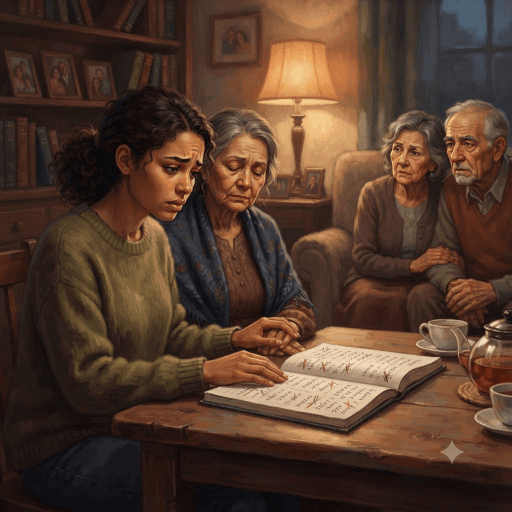
Our family dinners, once defined by comfortable predictability, transformed over several years into increasingly tense negotiations, as political disagreements that had always simmered quietly beneath the surface finally erupted into open, painful conflict.

My brother and I found ourselves on opposing sides of issues that felt, to each of us, fundamentally moral rather than merely political, making compromise seem less like reasonable accommodation than actual ethical betrayal.

Our mother, desperate to preserve some semblance of family unity, instituted an informal ban on political discussion during holidays, a rule that succeeded mainly in creating an exhausting atmosphere of careful, superficial avoidance.

This enforced silence proved unsustainable; unaddressed tensions inevitably surfaced through passive-aggressive comments, pointed questions disguised as innocent curiosity, and an underlying current of mutual disappointment neither of us could entirely conceal.

I began questioning whether maintaining relationship with my brother required abandoning positions I considered ethically non-negotiable, or whether genuine love might actually necessitate tolerating disagreement I found personally, viscerally troubling.

A particularly heated argument during last year's holiday finally forced explicit acknowledgment of what our careful avoidance had obscured: we genuinely feared that our fundamental disagreements reflected irreconcilable differences in basic values.

Following that difficult confrontation, we agreed to a deliberate experiment: monthly conversations focused specifically on understanding, rather than debating, the underlying experiences and fears informing each other's political positions.

These conversations didn't resolve our disagreements, nor did we expect them to, but they revealed shared anxieties and values beneath our opposing conclusions, evidence that our fundamental humanity exceeded our political categorization.

We still disagree profoundly on numerous issues, but we've learned to hold that disagreement alongside genuine love, discovering that family bonds, properly maintained, can accommodate far more ideological tension than we initially believed possible.

Tap any underlined word for its meaning.

1 / 9

About this lesson

A lesson in English for learners. It is written at B2 level, so Fluent conversation. Read it, listen where audio is available, tap words you do not know and finish with the quiz.

Frequently asked questions

What level is this lesson?
It is B2 (Upper-intermediate) on the CEFR scale: Fluent conversation.
Is this lesson free?
Yes. You can read the whole lesson for free. Free accounts have daily limits on word look-ups, quizzes and AI tools; Premium removes them.
How do I understand words I do not know?
Tap any word for its meaning, save it to your word list, and review it later with spaced repetition.


Up next for B2