Your interface language is the language you are learning Meanings and translations appear in the interface language, so they would only repeat the words. Switch the interface to a different language to look up words, translate sentences and see the meanings of your saved words.
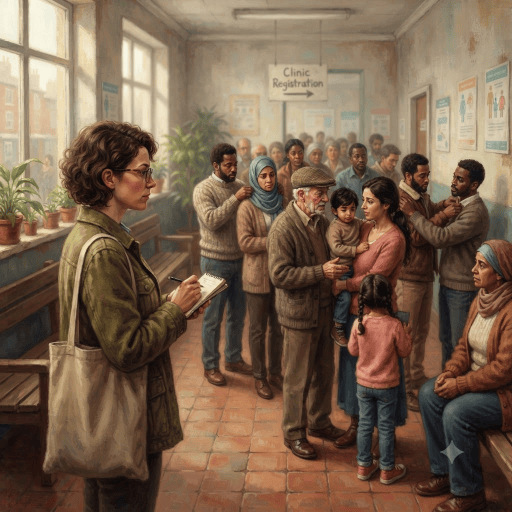
Change interface language Dr . Whitcombe had initially proposed her fieldwork as a modest , almost whimsical inquiry into an overlooked feature of public life , the seemingly unremarkable practice of queuing outside the community health clinic each morning before its doors opened , a subject her academic colleagues had gently teased as unworthy of the serious anthropological attention she intended to devote to it .
Her early observations , however , quickly revealed a social system considerably more intricate and consequential than the casual line she had originally anticipated documenting , an elaborate , almost entirely unwritten set of norms governing precisely who could claim a position , under what circumstances a place might be legitimately held for an absent party , and how disputes regarding queue position were negotiated and resolved without recourse to any formal authority beyond the collective judgment of those present .
What struck her most forcefully was how thoroughly the queue's informal governance reflected and reproduced broader social values that clinic patients , drawn from across the community's considerable economic and cultural diversity , might not otherwise have articulated so explicitly , a kind of practical , embodied philosophy regarding fairness that emerged through daily negotiation rather than through any formal deliberation .
Elderly patients , she observed , received an informal deference that allowed them earlier positions regardless of arrival time , a practice that nobody had formally established but that the queue's participants enforced with remarkable consistency , occasionally correcting newcomers unfamiliar with this unwritten but firmly held norm through gentle but unmistakable social pressure rather than explicit confrontation .
Parents with young children received similar accommodation , though Dr . Whitcombe noted with particular interest that this deference operated according to more contested and situational criteria than the relatively clear norm regarding elderly patients , generating occasional disputes that revealed genuine disagreement within the community regarding precisely how much accommodation parental status legitimately warranted compared to the straightforward temporal claim of simply having arrived earlier .
These disputes , when they occurred , resolved themselves not through any formal mediation but through an accumulated , almost choreographed process of appeal to shared , if imperfectly specified , community standards , longtime queue participants frequently serving an informal adjudicating function , their accumulated social authority within this specific context deriving entirely from sustained , visible participation in the queue's ongoing collective life rather than from any external status .
Dr . Whitcombe came to understand the queue as functioning , in effect , as a kind of miniature , continuously renegotiated constitution , a space where community members who might otherwise share little explicit common ground regarding broader questions of fairness and social obligation nonetheless collaboratively constructed and maintained a working , practical consensus regarding exactly these questions , applied to the specific , concrete circumstance of determining who received medical attention in what order .
This practical consensus proved considerably more sophisticated , she eventually argued in her published research , than the abstract philosophical accounts of distributive justice that dominated academic discourse on the subject , precisely because it had been forged through sustained , embodied negotiation among people with genuinely divergent interests and perspectives , rather than derived from the comparatively frictionless theoretical reasoning that characterized most scholarly treatments of fairness .
Her eventual monograph , while initially received with the mild skepticism her colleagues had originally displayed toward her chosen subject , gradually attracted serious attention from scholars recognizing that the queue's seemingly humble , unremarkable social choreography contained genuine insight into how communities actually constructed shared standards of fairness in practice , insight considerably harder to extract from the more formal , abstract sites of political philosophy that had traditionally monopolized scholarly attention to such questions .