Home/Podcasts

Would You Trust a Self-Driving Car?

Would You Trust a Self-Driving Car?

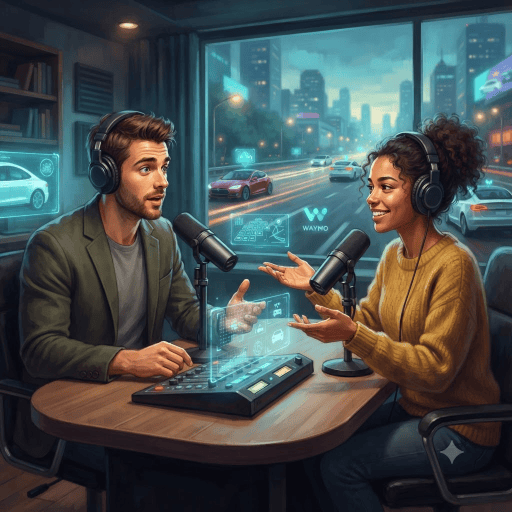
Jack and Emma discuss self-driving cars from companies like Tesla and Waymo. They talk about how the technology works, real accidents, and whether they would trust a car without a human driver.

PodcastB1Science & techFree to learnPrintable worksheet
15mAudioEnglish with translations in EnglishQuizzes
Your interface language is the language you are learningMeanings and translations appear in the interface language, so they would only repeat the words. Switch the interface to a different language to look up words, translate sentences and see the meanings of your saved words.
Jack Dawson

Hello everyone, and welcome back to the Heylangs Podcast. I'm Jack Dawson. Picture this: I'm sitting in the back seat, the steering wheel in front of me is turning by itself, and there is nobody, absolutely nobody, in the driver's seat. That was my first ride in a self-driving taxi in San Francisco last month, and honestly, it was one of the strangest experiences of my life. Today we're talking about self-driving cars.

Emma Wells

And I'm Emma Wells. I've never ridden in one myself, Jack, and I'm not sure my hands would have stayed as calm as yours. I've watched so many videos about them online, though. Companies like Waymo, Tesla, and Cruise have tested these cars for years, and in a few cities they're becoming a fairly normal sight.

Jack Dawson

Tell me about it, Emma. Once that Waymo car pulled away from the curb, I just kept staring at the empty driver's seat. The wheel moved, the car signalled, and nobody touched anything, which felt both amazing and a little scary at the same time.

Emma Wells

That does sound unsettling! How did the car actually know where to go and how to avoid other cars and pedestrians on the street?

Jack Dawson

From what I understand, these cars use a combination of cameras, radar, and something called LiDAR, which sends out laser beams to measure the distance to objects around the car. All of this data gets processed by artificial intelligence in real time.

Emma Wells

That's incredible technology. I read that Waymo cars have driven tens of millions of miles on public roads without a human driver, by the company's own count, plus billions more miles in computer simulations. That's a huge amount of real-world testing, which probably makes the system safer over time.

Jack Dawson

Exactly. But it hasn't been perfect. There have been several accidents involving self-driving cars, including some serious ones with Tesla's Autopilot system. A few of these accidents have even resulted in deaths, which raises a lot of tough questions.

Emma Wells

That's definitely concerning. I remember reading about a case where a Tesla crashed into a truck because the car's cameras couldn't properly recognize the white side of the trailer against a bright sky. It's a reminder that this technology still has serious limitations.

Jack Dawson

That's exactly the kind of situation that worries me. Human drivers make mistakes too, of course, but when a computer makes a mistake, it's harder to understand exactly why it happened and how to prevent it from happening again.

Emma Wells

That's a great point. Companies say that self-driving cars are statistically safer than human drivers overall, since computers don't get tired, distracted, or drunk. But convincing people to trust a machine with their life is a completely different challenge.

Jack Dawson

I felt that exact hesitation myself. Even though I knew the statistics, sitting in that car with no driver made my hands sweat a little. I kept watching the road as if I needed to be ready to grab the wheel.

Emma Wells

That's such a natural reaction. We're used to trusting a person's judgment, not lines of computer code. It probably takes time for people to build trust in this kind of technology, the same way people slowly got used to elevators without operators.

Jack Dawson

That's actually a really good comparison. A hundred years ago, people were afraid to step into an elevator without a trained operator controlling it. Now, nobody thinks twice about pressing a button and letting the elevator do the rest.

Emma Wells

Maybe self-driving cars will follow a similar path. But there's one more issue I keep thinking about: what happens when something goes wrong? Who is responsible if a self-driving car causes an accident, the passenger, the company, or the software itself?

Jack Dawson

That's one of the biggest legal questions right now, and honestly, nobody has a perfect answer yet. Some countries are creating new laws specifically for self-driving vehicles, but the rules are still changing quickly as the technology develops.

Emma Wells

It sounds complicated. On a more positive note, I've read that self-driving cars could really help people who can't drive themselves, like elderly people or people with certain disabilities. That kind of independence could change their lives significantly.

Jack Dawson

That's one of the aspects I'm most excited about. My football friend Tom's dad had to stop driving a few years ago because his eyesight got worse, and he really struggled with losing that independence, since he had to rely on neighbors just to get to his doctor's appointments. A reliable self-driving car could have made a huge difference for him.

Emma Wells

That's such a meaningful example. Self-driving technology could also reduce traffic jams if all the cars on the road could communicate with each other and coordinate their speed and movements more efficiently than human drivers currently do, especially during rush hour in crowded cities.

Jack Dawson

That would be amazing, especially in big cities where traffic is such a huge problem. Fewer traffic jams could also mean less pollution, since cars wouldn't be sitting still with their engines running for as long, and drivers wouldn't waste hours of their lives stuck in stressful traffic every single week.

Emma Wells

I hadn't thought about the environmental benefits before, but that makes a lot of sense. It's a good reminder that this technology could affect more than just how we get from place to place; it could also affect our air quality and how cities are designed in the future. What about jobs, though? A lot of people currently work as taxi drivers, truck drivers, and delivery drivers. What happens to them if self-driving cars become common?

Jack Dawson

That's a really important concern, and it's not just theoretical anymore. Truck driving is one of the most common jobs in some countries, and if self-driving trucks become widespread, millions of people could lose their jobs within a relatively short period of time.

Emma Wells

It's a difficult balance between progress and protecting people's livelihoods. I think governments and companies need to plan carefully for this transition, maybe by offering training programs for other types of jobs.

Jack Dawson

I completely agree. Technology moves forward whether we're ready or not, so it's better to prepare early rather than deal with the consequences later, once millions of people are suddenly out of work.

Emma Wells

There's also an interesting ethical question that people bring up a lot, sometimes called the trolley problem. If a self-driving car has to choose between hitting a pedestrian or crashing into a wall and hurting the passenger, how should it decide?

Jack Dawson

That question always makes my head spin a little. Programmers have to write rules for situations that most human drivers would never even think about consciously, since we usually just react instinctively in an emergency.

Emma Wells

Exactly, and different companies might program their cars to make different choices in the same situation. Some experts think there should be one global standard for these kinds of decisions, while others say it depends too much on local laws and culture.

Jack Dawson

That's such a tricky issue to solve. Weather is another challenge I hadn't really considered before my ride. Heavy rain, snow, or fog can confuse the cameras and sensors, which makes the car much less reliable in bad conditions.

Emma Wells

That makes sense. I read that most self-driving car testing happens in cities like Phoenix and San Francisco, partly because the weather there is usually clear and predictable. Testing in a snowy city like Chicago would probably be much harder.

Jack Dawson

That's a good point. I also read that some companies, like Cruise, actually had their testing permits suspended in San Francisco after a series of incidents, including one where a pedestrian was dragged after being hit by another vehicle first.

Emma Wells

I remember that story. It really shook public confidence in the technology, at least for a while. It shows how one serious incident can slow down progress for an entire industry, even if the overall safety record looks good on paper.

Jack Dawson

Right, and that's exactly why companies need to be extremely transparent about their safety data. If people feel like companies are hiding accidents or downplaying problems, trust disappears very quickly, and it's hard to rebuild.

Emma Wells

It's not just an American story either. In China, companies like Baidu are also testing self-driving taxis in several major cities, and they're investing huge amounts of money into this technology as part of a national strategy.

Jack Dawson

It really seems like a global race at this point. Whichever country masters this technology first could gain a huge economic advantage, especially in areas like logistics, delivery services, and public transportation.

Emma Wells

Speaking of cost, do you know how expensive this technology actually is? I imagine all those sensors and computers must add a lot to the price of a car.

Jack Dawson

From what I've read, a full self-driving system can cost tens of thousands of dollars, which is part of why these cars are still mostly used as taxis rather than sold directly to regular customers.

Emma Wells

That makes sense, since a taxi company can spread that cost across thousands of rides. I wonder if prices will drop over time, the way computers and smartphones became much cheaper as the technology matured.

Jack Dawson

I'd expect something similar to happen here too. Early technology is almost always expensive, and then costs come down once companies figure out how to manufacture the parts more efficiently and at a larger scale. That gives me some hope that this technology could eventually become affordable for regular families, not just taxi companies and wealthy early adopters.

Emma Wells

So, after your experience in that Waymo car, would you say you trust self-driving technology now, or are you still a little nervous about it?

Jack Dawson

Honestly, by the end of the ride, I felt much more relaxed than I expected. The car drove smoothly, stopped carefully at every crosswalk, and even waited patiently for a group of pedestrians who were crossing slowly. I'd definitely try it again.

Emma Wells

That's reassuring to hear. I think I'd still feel nervous the first time, but based on everything we've talked about today, I'm becoming more curious about trying it myself the next time I visit a city where it's available.

Jack Dawson

You should definitely try it, Emma. I think experiencing it firsthand really changes your perspective compared to just watching videos or reading articles about the technology online.

Emma Wells

One more thing I keep wondering about is insurance. If nobody is technically driving the car, how do insurance companies decide who pays when something goes wrong on the road?

Jack Dawson

That's a great question, and from what I understand, insurance companies are still figuring out new models for this. Some are starting to insure the software itself rather than just the driver, which is a completely different approach to risk.

Emma Wells

That makes sense in theory, but it must be really hard to calculate the risk of something as complicated as artificial intelligence making split-second decisions in traffic. There isn't a hundred years of data like there is for human drivers.

Jack Dawson

Exactly, and that uncertainty probably explains why insurance for these vehicles can still be quite expensive right now, even though the cars themselves are supposed to be statistically safer overall.

Emma Wells

I also wonder how these cars handle unusual situations, like construction zones or a police officer directing traffic with hand signals instead of following the normal traffic lights.

Jack Dawson

That's actually one of the hardest problems for engineers to solve. Human drivers can read body language and make quick judgments, but teaching a computer to understand a hand gesture takes an enormous amount of training data and testing.

Emma Wells

I imagine there must be thousands of unusual situations that engineers never even considered until the car actually encountered them on the road for the first time.

Jack Dawson

That's exactly why companies keep collecting data from every single ride, even the ones that go smoothly. Every unusual situation becomes new information that helps the system improve and handle similar cases better in the future.

Emma Wells

It sounds like a never-ending learning process. Do you think self-driving cars will completely replace human drivers someday, or will there always be some situations where a human needs to take control?

Jack Dawson

Honestly, I think it will take much longer than most tech companies originally promised. A lot of experts predicted fully self-driving cars would be everywhere by now, but the technology has faced far more challenges than anyone expected.

Emma Wells

That's true. I remember hearing bold predictions years ago that we'd all be riding in self-driving cars by now, and clearly that hasn't happened yet, at least not on a large scale outside a few specific cities.

Jack Dawson

Right, and I think that's an important lesson about new technology in general. Progress usually happens more slowly and unevenly than the most exciting headlines suggest, even when the underlying technology is genuinely impressive.

Emma Wells

That's a fair point to keep in mind. Still, even with all these challenges, I think it's exciting to be living through a time when this kind of technology is actually being tested on real streets with real passengers.

Jack Dawson

I completely agree. Whatever happens in the next ten years, I think we're witnessing one of the biggest transportation changes since cars first replaced horses over a century ago.

Emma Wells

That's a powerful way to think about it. It makes me appreciate how much courage it takes for engineers and companies to keep testing and improving this technology, even after setbacks and public criticism.

Jack Dawson

Definitely. I think the companies that succeed in the long run will be the ones that are honest about failures and keep prioritizing safety over speed, rather than rushing the technology out before it's truly ready.

Emma Wells

Now, listeners, we'd love to know what you think. Would you trust a self-driving car with your life? Have any of you already ridden in one? Send us a message and share your experience.

Jack Dawson

This was such a thought-provoking topic today. We covered some useful vocabulary, like autonomous, pedestrian, and livelihood. Try to use these words the next time you discuss technology or transportation with friends or classmates.

Emma Wells

Thanks so much for listening today, everyone. We really enjoyed exploring this topic together, and it definitely gave both of us a lot to think about long after we finished recording. Remember, a little practice every day makes a big difference. See you next time!

Tap any underlined word for its meaning.

What do you think?

  • How comfortable would you feel riding in a self-driving car with no human driver? What would make you more or less comfortable?
  • Who do you think should be responsible when a self-driving car causes an accident?
  • How do you think society should handle job losses caused by self-driving trucks and taxis?
0:00 / 0:00

About this lesson

Jack and Emma discuss self-driving cars from companies like Tesla and Waymo. They talk about how the technology works, real accidents, and whether they would trust a car without a human driver. It is written at B1 level, so Main ideas of real texts. Read it, listen where audio is available, tap words you do not know and finish with the quiz.

Frequently asked questions

What level is this lesson?
It is B1 (Intermediate) on the CEFR scale: Main ideas of real texts.
Is this lesson free?
Yes. You can read the whole lesson for free. Free accounts have daily limits on word look-ups, quizzes and AI tools; Premium removes them.
How do I understand words I do not know?
Tap any word for its meaning, save it to your word list, and review it later with spaced repetition.