Home/Podcasts

Cooking Together: A Family Tradition

Cooking Together: A Family Tradition

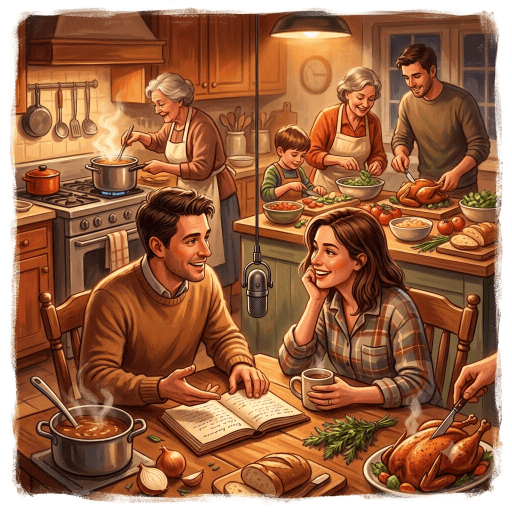
Jack and Emma explore the theater of multi-generational holiday cooking, from fiercely contested gravy recipes to the tacit, unwritten knowledge older relatives carry, examining how family food traditions transmit meaning, adapt across generations, and confront overlooked gendered labor dynamics.

PodcastC2FoodFree to learnPrintable worksheet
19mAudioEnglish with translations in EnglishQuizzes
Your interface language is the language you are learningMeanings and translations appear in the interface language, so they would only repeat the words. Switch the interface to a different language to look up words, translate sentences and see the meanings of your saved words.
Jack Dawson

Hello everyone, and welcome back to the Heylangs Podcast. I'm Jack Dawson. Picture a kitchen in Leeds, roughly three meters square, containing my mother, my sister Laura, her two children, a beagle who has no business being there, and one enormous turkey. Now add me, whose only assigned job is peeling potatoes, and who still manages to be in everyone's way. Today's conversation is one I've genuinely been looking forward to, because we're talking about cooking together as a family tradition, and all the wonderfully messy, occasionally fraught, and ultimately bonding rituals that unfold whenever multiple generations end up crammed into the same kitchen.

Emma Wells

And I'm Emma Wells. I want it on record that peeling potatoes is a job you can, in fact, get wrong, Jack. I have to say, few things in life generate quite as much simultaneous joy and low-grade chaos as an entire family attempting to cook a holiday meal together, each person absolutely convinced their particular method is the only correct one, regardless of what anyone else in the room might think.

Jack Dawson

That tension you're describing is practically a genre unto itself in my family. Every Christmas devolves into what I can only describe as a good-natured turf war over the gravy, with my mother and my sister Laura each insisting their technique is superior, while my dad, the kids, and I simply try to stay out of the crossfire and enjoy the show.

Emma Wells

It's fascinating, isn't it, how something as ostensibly straightforward as gravy can become such fiercely contested territory? I think it speaks to something deeper than mere culinary preference; these disputes are often proxy battles for identity, memory, and a kind of unspoken competition over who gets to define what the family's shared traditions actually mean.

Jack Dawson

That's a wonderfully astute observation, and it resonates with something I've noticed in my own family too. The recipes themselves almost become secondary to the ritual of arguing about them, a kind of theater that everyone unconsciously participates in year after year, precisely because the predictability of the conflict is itself oddly comforting and familiar.

Emma Wells

Absolutely, and I'd go further and suggest that the friction is often what makes the memory stick, paradoxically. Nobody reminisces fondly about the year everything went smoothly and nobody argued about anything; it's invariably the burnt pie, the overcooked turkey, or the epic standoff over stuffing seasoning that becomes the story told and retold for decades afterward.

Jack Dawson

That rings entirely true in my experience. There was one Christmas where my dad insisted on adding an entire bottle of sherry to the trifle, against everyone's explicit objections, and to this day, fifteen years later, we still bring it up every single holiday, half in exasperation and half in genuine, if reluctant, affection for his stubbornness.

Emma Wells

Those stories become a kind of oral tradition unto themselves, don't they, almost more durable than the recipes they're ostensibly about. I think there's something profoundly human about how we curate and embellish these small domestic dramas over time, transforming what was likely a mildly annoying moment into cherished family lore.

Jack Dawson

Let's talk about generational transmission a bit more directly, since I think that's really the heart of why family cooking traditions matter so much beyond the immediate pleasure of the meal itself. How does your family actually pass down techniques and recipes, given that a lot of older relatives, at least in my experience, are notoriously reluctant to write anything down precisely?

Emma Wells

That reluctance is almost universal, isn't it? My Nan in Cardiff has flatly refused, on multiple occasions, to commit her stuffing recipe to paper, insisting that it simply can't be properly conveyed through written instructions alone, that it requires standing beside her in the kitchen, absorbing the technique through observation and repeated, patient practice rather than mere transcription.

Jack Dawson

There's actually a compelling argument buried in that stubbornness, I think, however maddening it might feel to those of us who'd prefer a tidy, replicable recipe card. Certain culinary techniques genuinely resist codification; the exact texture of dough, the precise moment a sauce has reduced sufficiently, these are sensory judgments that words alone struggle to fully capture.

Emma Wells

That's precisely the tacit knowledge problem that anthropologists and cognitive scientists have written about extensively, where certain skills are transmitted far more effectively through embodied apprenticeship than through explicit instruction. My Nan, without any formal training in pedagogy whatsoever, has intuitively grasped something that a lot of instructional design theory takes considerable effort to articulate.

Jack Dawson

I find that framing genuinely illuminating, actually, because it reframes what might otherwise seem like mere sentimentality or stubbornness as a sophisticated, if entirely unconscious, pedagogical instinct. It also explains why so many of us feel a genuine sense of loss when an older relative passes away without having fully transmitted their particular culinary repertoire to the next generation.

Emma Wells

That loss is genuinely profound, and I think it's underappreciated in broader cultural conversations about grief and inheritance. We tend to focus on material possessions or explicit stories when discussing what's lost when an elder passes, but the embodied knowledge, the specific hand movements, the intuitive sense of when a dish is properly seasoned, often disappears far more silently and irrevocably.

Jack Dawson

I've actually started recording videos of my mother cooking whenever I'm up in Leeds, partly motivated by exactly that concern, hoping to at least partially preserve some of that embodied knowledge before it's lost entirely. It feels like a somewhat inadequate substitute for genuine apprenticeship, but it's considerably better than relying purely on memory or a sparse, inadequate written recipe.

Emma Wells

That's such a thoughtful preemptive measure, and I suspect a lot of families would benefit from adopting something similar before it's too late. There's a poignant urgency to these traditions that often only becomes apparent retrospectively, once the person who embodied that knowledge is no longer available to consult, correct, or demonstrate the technique in person.

Jack Dawson

Let's discuss how these traditions evolve and adapt across generations too, since I don't think family cooking rituals remain static; they seem to accrue modifications, sometimes contentious ones, as each new generation asserts its own preferences, dietary restrictions, or simply different tastes onto what was previously considered an immutable, sacred recipe.

Emma Wells

That evolutionary pressure is fascinating to observe within my own family, actually. My brother Rhys recently went vegan at university, which initially caused considerable consternation among the more traditionalist relatives, Nan included, but has ultimately led to some genuinely delicious plant-based adaptations of dishes that had previously been considered non-negotiable in their original, meat-heavy form.

Jack Dawson

That adaptability strikes me as a healthy sign, honestly, rather than a dilution of tradition, as some of the more conservative voices in a family might initially perceive it. A tradition that can't accommodate legitimate change, whether driven by dietary necessity, ethical conviction, or simply evolving taste, risks becoming a brittle museum piece rather than a living, sustaining practice.

Emma Wells

I completely agree, and I think the families that navigate these transitions most gracefully tend to distinguish between the essential spirit of a tradition, gathering together, expressing care through shared labor and food, and the specific, incidental details, like whether the stuffing contains meat, which can flex considerably without genuinely threatening what actually matters about the ritual.

Jack Dawson

That distinction between essence and incidental detail seems like a genuinely useful heuristic, not just for cooking traditions but for thinking about cultural continuity more broadly. It suggests that preserving a tradition's meaning doesn't necessarily require rigidly preserving every specific detail, which I think offers a more sustainable path forward than an uncompromising insistence on exact replication.

Emma Wells

Let's also touch on the labor dynamics involved in these family cooking rituals, since I think there's often an uncomfortable gendered history lurking beneath the nostalgic surface, where certain family members, historically women, bore a disproportionate burden of holiday cooking labor while receiving comparatively less credit or recognition for the considerable effort involved.

Jack Dawson

That's an important and often uncomfortable dimension to acknowledge honestly, rather than romanticizing these traditions uncritically. I've watched my own family gradually redistribute cooking responsibilities more equitably across genders over the past decade or so, which has genuinely improved the experience for everyone involved, including the relatives who previously bore an unfair share of the labor.

Emma Wells

That redistribution seems like a genuinely positive evolution, and I'd argue it actually strengthens rather than diminishes the tradition, since involving more family members directly in the cooking process tends to deepen everyone's investment in and connection to the ritual, rather than reducing it to a passive experience for those who simply show up to eat.

Jack Dawson

I want to circle back to something you touched on earlier, the idea that certain family recipes become almost sacred, immune to any proposed modification, no matter how sensible the suggested change might be. I'm curious whether you've noticed particular categories of dishes that seem more susceptible to this kind of fierce, almost dogmatic preservation than others.

Emma Wells

That's a wonderfully specific question, and yes, I've noticed a distinct pattern, at least anecdotally. Dishes tied to a deceased relative seem to acquire an almost untouchable status, as though modifying the recipe would constitute some kind of betrayal or erasure of that person's memory, whereas dishes associated with living relatives remain considerably more open to negotiation and revision.

Jack Dawson

That's a fascinating observation, and it suggests something quite profound about how food functions as a vessel for grief and memory, effectively freezing a relationship in amber at the moment of loss, such that any subsequent alteration to the associated recipe feels less like a culinary decision and more like a small, symbolic act of forgetting.

Emma Wells

Precisely, and I think that dynamic explains why disputes over these particular dishes tend to be so much more emotionally charged than disagreements over, say, which side dish to serve alongside the main course. The stakes feel existential in a way that's disproportionate to the actual culinary consequences of, say, using slightly less butter than the original recipe called for.

Jack Dawson

I've witnessed exactly that kind of disproportionate intensity firsthand, in my friend Tom's family. When his aunt suggested reducing the sugar in his late grandmother's shortbread recipe, purely for dietary reasons given some family members' diabetes diagnoses, it triggered what he described as a minor family crisis, with several relatives interpreting the proposal as tantamount to dishonoring her memory entirely.

Emma Wells

That reaction, while perhaps disproportionate on its surface, actually makes a certain emotional sense once you consider the symbolic weight these recipes carry. I think the resolution, in cases like that, often involves finding some middle path, perhaps preparing both versions, that allows the sacred original to persist alongside a modified variant that accommodates evolving practical needs.

Jack Dawson

That compromise solution seems remarkably wise, honestly, and I've seen similar diplomatic resolutions emerge in my own family over the years. We now prepare two versions of my dad's chili, one faithfully following his notoriously fiery original recipe, and a milder variant for relatives, myself included as I've gotten older, who've developed a somewhat reduced tolerance for extreme heat.

Emma Wells

That dual-track approach seems like a genuinely elegant solution to what might otherwise become an intractable conflict, allowing the tradition's symbolic core to remain intact while still accommodating the practical, evolving needs of an aging or diversifying family. It strikes me as a model that could usefully be applied well beyond just cooking, honestly, to a whole range of family traditions under similar generational strain.

Jack Dawson

Let's discuss the role of technology in all of this too, since I think platforms like family group chats and shared digital recipe archives have started to change how these traditions get documented and transmitted, potentially addressing some of the preservation anxieties we discussed earlier regarding unwritten, embodied knowledge disappearing along with the relatives who hold it.

Emma Wells

That's an encouraging development, though I remain somewhat cautious about whether digital documentation can genuinely substitute for embodied apprenticeship. My family started a shared document years ago attempting to catalog everyone's recipes, but I've noticed the entries from older relatives remain frustratingly vague, still relying on phrases like a pinch of this or until it looks right, precisely the imprecision we discussed earlier.

Jack Dawson

That persistent vagueness suggests the underlying tacit knowledge problem hasn't actually been solved by digitization, merely relocated to a different medium. Perhaps the more valuable technological intervention isn't written documentation at all, but rather video recording, which at least captures something of the sensory, embodied dimension that pure text simply cannot convey no matter how carefully worded.

Emma Wells

I'd agree with that assessment, and I've noticed a growing trend of younger relatives filming cooking sessions with older family members specifically for this reason, treating it almost like an oral history project, complete with questions about the recipe's origins, memories associated with particular dishes, and the stories behind why certain modifications were made over the decades.

Jack Dawson

That oral history framing feels particularly apt, honestly, because it captures something these recipes always implicitly contained but rarely explicitly articulated, namely that the food itself is inseparable from the accumulated stories, relationships, and historical circumstances that shaped it, none of which a simple list of ingredients and measurements could ever hope to adequately convey.

Emma Wells

Let's touch briefly on immigrant families too, since I imagine these dynamics take on additional layers of complexity when the family's culinary traditions are also tied to a homeland that subsequent generations may have never personally visited, adding questions of cultural authenticity and adaptation on top of the generational tensions we've already discussed.

Jack Dawson

That's such an important dimension, and one I've observed among several friends from immigrant families. There's often a delicate negotiation between maintaining fidelity to a homeland's traditional recipes, sometimes using ingredients that are difficult to source locally, and adapting those recipes using available substitutes, which can itself become a fraught symbol of assimilation versus cultural preservation.

Emma Wells

I've heard friends describe genuine anguish over these substitutions, worrying that using a locally available ingredient instead of the traditional one somehow dilutes the dish's authenticity or their connection to a homeland that, for second or third generation immigrants, may exist more as an inherited memory than a lived, firsthand experience of their own.

Jack Dawson

That anguish speaks to how much weight we ask food to carry within immigrant families specifically, functioning simultaneously as sustenance, cultural anchor, and a tangible link to a place and history that might otherwise feel increasingly abstract or distant with each successive generation born and raised somewhere entirely different from where the tradition originated.

Emma Wells

There's another dimension worth exploring here too, I think, which is how these traditions function as a kind of temporal anchor, marking the passage of years in a way that ordinary calendar dates simply don't. People often measure their lives by which holiday meal corresponds to a particular life stage, before a divorce, after a move, the first Christmas with a new baby at the table.

Jack Dawson

That's such a resonant point, and it explains why these gatherings carry such disproportionate emotional weight compared to their actual duration. A single afternoon of cooking and eating together becomes a kind of load-bearing pillar in someone's personal chronology, a fixed point against which all the surrounding, more chaotic changes in life get measured and remembered.

Emma Wells

I think that's precisely why an empty chair at one of these gatherings feels so acutely painful, whether due to death, estrangement, or simply geographic distance. The ritual's very structure, its unchanging repetition year after year, makes any absence conspicuously visible in a way that might otherwise pass unnoticed amid the ordinary flux of daily life.

Jack Dawson

That observation makes me think about how families sometimes deliberately modify a recipe or a seating arrangement specifically to accommodate grief, as though the ritual itself needs to be renegotiated to make space for loss, rather than simply proceeding as though nothing had changed, which would feel almost dishonest given the obvious absence everyone is quietly aware of.

Emma Wells

My university friend Hannah's family did exactly that after her grandfather passed away, actually. Three generations still gather at her parents' house every Christmas, and nobody sits in his old chair at the head of the table anymore; they've left a small, unspoken gap there for the past several years. It's never been explicitly discussed, yet everyone somehow understands and honors that particular, quietly negotiated modification to the ritual.

Jack Dawson

That kind of unspoken, collectively understood adaptation seems like a genuinely sophisticated form of social coordination, achieved without any explicit negotiation or discussion whatsoever. It suggests these rituals carry an almost self-correcting quality, capable of absorbing and encoding grief, celebration, or change without requiring anyone to formally articulate the shift taking place.

Emma Wells

Let's also discuss what happens when families blend or merge, through remarriage or new partnerships, since that introduces an entirely different negotiation, where two sets of previously distinct culinary traditions suddenly need to coexist, compete, or merge within a single holiday gathering, often with considerable diplomatic delicacy required from everyone involved.

Jack Dawson

That's a scenario I've witnessed play out next door, honestly, when my neighbor Daniel's mother remarried and her new husband brought an entirely different set of holiday traditions from his own family background. Daniel described a genuinely awkward transitional period where nobody quite knew whose stuffing recipe should take precedence, or whether both should simply coexist on the same table.

Emma Wells

How did that particular negotiation ultimately resolve itself, if you don't mind me asking? I imagine there's rarely a clean, universally satisfying resolution to that kind of blended-family culinary diplomacy, given how emotionally loaded these traditions tend to be for everyone involved, regardless of which side of the newly merged family they originally belonged to.

Jack Dawson

It took a few genuinely awkward years, from what Daniel tells me, but eventually the family settled into an arrangement where both stuffing recipes are prepared side by side, almost as competing exhibits, with everyone free to sample both and privately, or sometimes not so privately, declare their preference without it becoming an overt referendum on family loyalty.

Emma Wells

That resolution strikes me as a wonderfully pragmatic compromise, honestly, allowing both traditions to persist without forcing an artificial, potentially painful choice between them. It also subtly acknowledges that traditions can multiply and coexist within an expanding family rather than necessarily requiring one to be sacrificed for the sake of the other's continuity.

Jack Dawson

I think that expansive, additive model of tradition, rather than a purely substitutive one, offers a genuinely useful template for thinking about how families grow and change over time more broadly. Rather than treating new members as threats to an existing tradition, incorporating their contributions can actually enrich and diversify what the family's shared culinary repertoire ultimately becomes.

Emma Wells

Before we wrap up, I'm curious what you think the future holds for these kinds of elaborate, multi-generational cooking traditions, given how busy, geographically dispersed, and time-constrained modern families often are compared to previous generations who may have lived in closer proximity and had more time available for such labor-intensive gatherings.

Jack Dawson

I'm cautiously optimistic, honestly, despite the genuine pressures you've just described. I think there's a countervailing hunger, particularly among younger generations who've grown up amid considerable digital disconnection, for exactly this kind of embodied, tactile, intergenerational ritual, even if it takes a somewhat different, perhaps more streamlined, form than it did for our grandparents' generation.

Emma Wells

That's a genuinely hopeful note to end on, and it suggests these traditions, however they might need to adapt to modern circumstances, aren't simply relics destined for extinction, but rather living practices capable of finding new expression as each generation figures out what aspects of the ritual genuinely matter enough to be worth preserving and passing forward.

Jack Dawson

Remember, a little practice every day makes a big difference, whether you're carrying forward a cherished family recipe, negotiating a newly blended family's competing traditions, or steadily building fluency in a new language, one small, deliberate effort at a time. Today has been a reminder that the mess, the arguments, and the imperfect compromises are often exactly what make these gatherings feel so genuinely, irreplaceably alive. Whatever shape those gatherings take in the years ahead, I suspect the impulse to gather, cook, and argue affectionately over a shared meal will endure in some form. And honestly, that unpredictability, the arguments included, is probably what keeps everyone coming back year after year without fail. Keep listening, keep speaking, and keep gathering around the table with the people who matter most to you. See you next time!

Tap any underlined word for its meaning.

What do you think?

  • What role do arguments or friction play in shaping the family stories we tell about cooking and holidays?
  • How do you think embodied, unwritten culinary knowledge should be preserved across generations?
  • When is adapting a family food tradition to new values and needs a healthy sign, and when does it risk losing something essential?
0:00 / 0:00

About this lesson

Jack and Emma explore the theater of multi-generational holiday cooking, from fiercely contested gravy recipes to the tacit, unwritten knowledge older relatives carry, examining how family food traditions transmit meaning, adapt across generations, and confront overlooked gendered labor dynamics. It is written at C2 level, so Nuance and style. Read it, listen where audio is available, tap words you do not know and finish with the quiz.

Frequently asked questions

What level is this lesson?
It is C2 (Mastery) on the CEFR scale: Nuance and style.
Is this lesson free?
Yes. You can read the whole lesson for free. Free accounts have daily limits on word look-ups, quizzes and AI tools; Premium removes them.
How do I understand words I do not know?
Tap any word for its meaning, save it to your word list, and review it later with spaced repetition.
Cooking Together: A Family Tradition (English C2) | Heylangs