Home/Podcasts

Chasing the Unspoiled: Travel, Authenticity, and the Gaze We Bring With Us

Chasing the Unspoiled: Travel, Authenticity, and the Gaze We Bring With Us

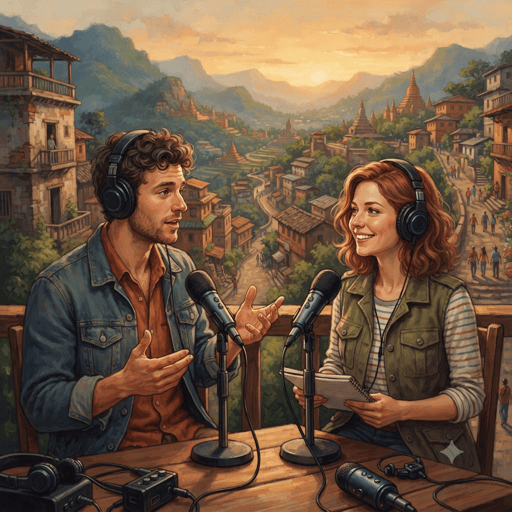
We say we want the 'real' version of a place, untouched by tourism — yet we arrive by the millions precisely because someone told us it was real. Jack and Emma unpack the tourist gaze, staged authenticity, and the uncomfortable colonial history tangled up in our search for the authentic.

PodcastC2TravelFree to learnPrintable worksheet
18mAudioEnglish with translations in EnglishQuizzes
Your interface language is the language you are learningMeanings and translations appear in the interface language, so they would only repeat the words. Switch the interface to a different language to look up words, translate sentences and see the meanings of your saved words.
Jack Dawson

Hello everyone, and welcome back to the Heylangs Podcast. I'm Jack Dawson. Somewhere right now, a traveler is standing in a village square, deeply pleased to have found a place with no other tourists in it, taking a photograph they will post within the hour so that everyone knows. Today we're tackling something that makes a lot of well-meaning travelers faintly uncomfortable once they start examining it closely: the peculiar, almost impossible thing we mean when we say we want an 'authentic' travel experience. We say we want to see the 'real' version of a place, away from the tourist traps, among people supposedly 'untouched' by tourism — and yet we arrive by the millions, cameras in hand, precisely because someone told us this place was authentic in the first place. There's a paradox baked into the very language of travel that most of us never quite interrogate, and it's worth pulling apart today, because it touches on economics, anthropology, and, frankly, a fair bit of uncomfortable colonial history too.

Emma Wells

And I'm Emma Wells. That traveler in the square has a name in the literature, Jack, or at least their way of looking does. The sociologist John Urry gave this dynamic a name back in 1990 — the 'tourist gaze' — his argument being that we don't simply look at a place neutrally when we travel, we look at it through a set of expectations manufactured well in advance, by postcards, films, guidebooks, and now, overwhelmingly, by other people's Instagram feeds. We arrive in Santorini already primed to photograph white walls and blue domes at golden hour, because we've seen that exact photograph five hundred times before we ever booked the flight. Urry's darker point is that the gaze doesn't just interpret a place — it actively reshapes it. Towns start repainting buildings the 'expected' color, restaurants quietly adjust their menus toward what visitors imagine local food should taste like, and entire local economies gradually reorganize themselves around performing a version of authenticity that was, in a sense, scripted somewhere else entirely, often by a marketing board that has never set foot there. You can watch the same mechanism run at algorithmic speed now: Trolltunga, that dramatic rock ledge in Norway, reportedly drew only a few hundred visitors a year before it started circulating on Instagram; within a decade the number had climbed past eighty thousand annually, with mountain rescue services reporting a spike in hikers arriving in trainers because the photograph gave no sense of the six-hour round trip involved. The image travels faster and further than any accurate description of the place ever could, which means the gaze increasingly arrives pre-loaded with expectations the location itself was never built to satisfy. Before we even get to staging, it's worth naming the more basic architecture Erik Cohen described back in the 1970s — what he and others called the 'environmental bubble.' Most mass tourism doesn't actually deliver contact with a foreign environment so much as it delivers a carefully insulated capsule moving through one: the air-conditioned coach, the resort with its familiar buffet and its pool bar serving drinks with the same six names everywhere on earth, the guided walking tour that keeps you fifteen feet from anything unscripted. Cohen's insight was that most travelers don't actually want the full, unmediated shock of difference — they want a controlled dose of it, novelty administered at a tolerable strength, the way you might want your coffee slightly stronger than usual rather than replaced entirely with something you've never tasted. The bubble isn't a failure of the industry to deliver authenticity. It's often precisely what's being purchased, whether or not the purchaser would ever admit that to themselves out loud.

Jack Dawson

This is where the sociologist Dean MacCannell's idea of 'staged authenticity' becomes almost unbearably relevant. Back in the seventies, he argued that modern tourism industries construct front stages — the market, the ceremony, the craft demonstration — deliberately designed to feel like a backstage glimpse into 'real' local life, while the actual backstage, where people simply live ordinary, unphotogenic lives, stays carefully closed off. The tourist senses, correctly, that there's a curtain somewhere, and spends the whole trip trying to get behind it — but the industry has usually already anticipated that exact desire and built a second, more convincing curtain one layer further in. It's staging behind staging, nearly all the way down, and the exhausting part is that knowing this doesn't actually stop the craving for the 'real' thing. If anything, it sharpens it considerably.

Emma Wells

There's a genuine economic paradox tangled up in all this too, one that geographers and travel writers have both wrestled with: globalization is simultaneously making every city easier to reach and, in important ways, more similar to every other city — the same coffee chains, the same storefronts, the same algorithmically-recommended rooftop bar — while travelers' appetite for the singular, the unrepeatable, the untouched, keeps intensifying in almost direct proportion. So the market responds, predictably, by manufacturing scarcity and uniqueness as a product category of its own: 'hidden gem' tours, 'off the beaten path' guides that then themselves become the beaten path within eighteen months, eco-lodges marketed on precisely how few other guests will be there at any given time. We are, in effect, purchasing the feeling of discovery as a packaged commodity, which is a genuinely strange thing to want to buy, once you actually say it out loud.

Jack Dawson

There's also a heavier historical undertow here worth naming plainly rather than dancing around. A great deal of what gets marketed as 'exotic' or 'unspoiled' travel inherits, often quite unconsciously, patterns Edward Said described in Orientalism decades ago — a Western gaze that frames certain parts of the world as timeless, simple, and essentially available for the visitor's consumption and self-discovery, in a way that flattens the actual, complicated, thoroughly modern lives of the people who live there. The backpacker who describes a Southeast Asian fishing village as feeling like 'stepping back in time' isn't making a neutral observation — they're often projecting a fantasy of pre-modernity onto a place that has smartphones, elections, debt, and ambition, exactly like everywhere else on the planet. None of this means travel is inherently exploitative. It means the gaze we bring is never quite as innocent or as purely aesthetic as it feels from inside our own head, and it's worth at least occasionally asking whose story we're actually telling when we describe somewhere as timeless. There's an interesting material dimension to all this too, in the humble form of the souvenir. Anthropologists studying material culture have pointed out that souvenirs perform a very specific psychological function — they're not really about the object itself, which is frequently cheap, mass-produced, and often not even made anywhere near where it's sold; they're about transferring a fragment of the trip's meaning into something durable enough to survive the return home, when the memory itself starts to blur and compress. That's precisely why the market for souvenirs has industrialized so thoroughly and so strangely — the carved elephant, the fridge magnet, the miniature Eiffel Tower stamped 'Made in' somewhere else entirely, are commodified memory tokens more than they are craft objects, and the fact that so many of them are visibly, almost comically inauthentic rarely seems to bother the person buying one, because the object was never really required to be authentic. It only had to be able to sit on a shelf later and successfully summon the feeling back.

Emma Wells

There's a starker version of this same commodifying instinct in what's sometimes called 'poverty tourism' or slum tourism — organized visits to favelas in Rio, townships in South Africa, or informal settlements in Mumbai, marketed explicitly on the promise of unfiltered, 'real' life rather than a curated tourist zone. Defenders argue it can redistribute income directly to under-visited communities and correct sanitized, dishonest narratives about a city; critics, including many residents of the communities in question, argue it converts poverty itself into spectacle, turning someone's actual, difficult daily life into the very 'backstage' MacCannell described tourists chasing, except now the backstage is somebody's real front door rather than a constructed performance at all. Both things can be true simultaneously, which is precisely what makes the ethics of it so genuinely uncomfortable to sit with rather than resolve neatly in either direction.

Jack Dawson

Then there's the way the aesthetic itself has started to homogenize globally, almost regardless of geography, which the writer Kyle Chayka has usefully termed 'AirSpace' — that eerily consistent look of reclaimed wood, hanging Edison bulbs, and pale minimalist signage you now encounter in coffee shops from Lisbon to Seoul to Melbourne, all optimized, whether consciously or not, to photograph well for the same platforms. The algorithm doesn't just document the tourist gaze anymore, in other words — it actively trains it, and increasingly, it trains the places themselves right back, because venue owners can see exactly which interiors perform well online and renovate accordingly. The unspoiled, distinctive local café is, in a very real sense, competing for survival against a template that photographs better, and the tourist arriving in search of local color risks instead finding a slightly warmer, slightly more sun-drenched version of the exact café they left behind at home.

Emma Wells

Daniel Boorstin, writing even earlier than Urry, back in the early 1960s, coined the term 'pseudo-event' for exactly this kind of manufactured experience — an event staged specifically to be reported, photographed, and consumed, rather than arising organically out of local life. He was writing about media and publicity generally, but travel turned out to be one of the pseudo-event's most fertile habitats. The luau, the flamenco show timed precisely to the cruise ship's docking schedule, the 'traditional' dance performed nightly at eight for whichever busload happens to be present that evening — these aren't fraudulent exactly, the performers are real, the craft is often genuinely skilled, but the event exists because tourists exist, in a kind of closed economic loop, rather than because the community would otherwise be doing this on an ordinary Tuesday evening regardless of who was watching. Boorstin's broader worry, worth remembering, was that pseudo-events gradually crowd out our appetite for the unscripted kind — we come to prefer the vivid, well-lit, easily photographed performance of a place over the messier, harder-to-frame reality sitting just behind it.

Jack Dawson

There's a psychological dimension to all this too, which I think connects back to why any of it matters emotionally in the first place. The way we remember a trip is rarely a faithful transcript of what actually happened — it's a story we construct afterward, selectively, favoring the moments that fit a narrative we already wanted to tell about ourselves: the adventurous one, the culturally sensitive one, the person who found the hidden alleyway nobody else found. Psychologists studying autobiographical memory call this narrative identity — we don't just recount our travels, we use them to author who we believe ourselves to be. Which means the pressure to have an 'authentic' experience is often less about the destination itself and more about needing evidence for a self-concept we're quietly trying to prove, to other people and, honestly, to ourselves as well.

Emma Wells

There's a lovely, if slightly melancholy, way of framing this borrowed from Walter Benjamin's essay on mechanical reproduction, even though he was writing about art rather than travel. Benjamin argued that an original artwork possesses an 'aura' — a unique presence rooted in a specific time and place — that gets diluted the moment it's endlessly reproduced and consumed at scale. You could say much the same about a coastal village, a temple, a viewpoint: the very qualities that made it feel singular and auratic are precisely what draw the crowds that dilute that singularity, turn by turn, tour bus by tour bus, geotagged photo by geotagged photo. It isn't that any individual traveler is destroying the place. It's that the aggregate weight of everyone chasing the same rare feeling, quite literally, redistributes it into something far more ordinary — a phenomenon researchers now bluntly call 'overtourism.'

Jack Dawson

There's important pushback within tourism studies itself against the idea that host communities are simply passive backdrops absorbing the gaze without any agency of their own. The anthropologist Edward Bruner, who conducted extensive fieldwork in Bali and Indonesia, argued that framing locals purely as victims of an intrusive tourist gaze is itself a kind of condescension — it erases how actively communities negotiate, adapt, and sometimes deliberately perform a version of themselves for economic and even political reasons entirely their own. Balinese dance troupes, he pointed out, have reshaped their own performances for tourist audiences for nearly a century, and in doing so have also preserved, funded, and revitalized traditions that might otherwise have faded under pressures entirely unrelated to tourism. Staging isn't automatically loss. Sometimes it's exactly how a tradition survives long enough to still be there for anyone, tourist or otherwise, to encounter at all. We should also name the specific mechanism behind that phrase 'stepping back in time,' because the anthropologist Johannes Fabian gave it a precise, rather devastating name in his book Time and the Other — what he called the 'denial of coevalness.' His argument was that anthropology, and by extension a great deal of travel writing, has long had a habit of describing the people it studies as existing in a different, earlier temporal moment than the observer, even when both parties are standing in the same present, on the same afternoon, checking the same time on their phones. Calling a village 'untouched by time' or a culture 'living in the past' isn't a harmless compliment — it quietly denies those people full membership in the contemporary world the traveler assumes only they themselves fully occupy. It's a subtle rhetorical move, and a strikingly durable one, showing up constantly in nature documentaries and travel blogs alike, almost always aimed in the same geographic direction.

Emma Wells

There's an ecological paradox worth folding in here too, because the search for the untouched increasingly has a very touchable carbon cost attached to it. Ecotourism markets itself, often sincerely, as a way of funding conservation by making pristine wilderness economically valuable enough to protect — and there's real evidence it can work, from gorilla trekking permits in Rwanda to marine park fees in parts of Southeast Asia that directly fund ranger patrols and reef protection. But getting relatively small numbers of travelers to genuinely remote, 'unspoiled' locations is disproportionately carbon-intensive per visitor compared to mass tourism at established destinations, precisely because remoteness and low visitor density are the very qualities being sold. Chasing the untouched, in other words, can quietly accelerate the conditions that touch it, and the traveler seeking the most pristine, least-visited corner of the planet is very often, per capita, doing the most damage to keep it that way for anyone else. Some researchers have started calling this the 'last chance tourism' effect — melting glaciers and bleaching reefs generating a surge of visitors racing to see them specifically before they vanish, which is a poignant motive on the surface and, on closer inspection, a fairly direct contribution to the very disappearance being mourned.

Jack Dawson

There's a more hopeful philosophical distinction I keep coming back to on this point, borrowed loosely from Michel de Certeau's writing on everyday life — his contrast between 'strategies,' the top-down plans imposed by institutions and industries mapping out how a space should be used, and 'tactics,' the improvised, ground-level ways ordinary people actually move through and repurpose that same space regardless of the plan. Staged authenticity, tourist bubbles, AirSpace cafés — these are all strategies, in de Certeau's sense, engineered from above. But a traveler willing to get slightly lost, ask a stranger for directions rather than trusting the map, or return to the same unremarkable street corner three days running out of simple curiosity, is practicing tactics instead — quietly reclaiming a version of the place that wasn't designed for them at all, and precisely because of that, tends to feel considerably more real. None of this requires heroics or an unusual tolerance for discomfort — it's closer to a small, repeatable habit of preferring the unplanned turn to the marked route whenever the stakes of getting it wrong are genuinely low.

Emma Wells

So is there any honest way to travel at all, given everything we've just said, or are we simply doomed to be tourists performing tourism for each other in an infinite hall of mirrors? I don't think it's quite that bleak. A few threads in the research and in travel writing itself point somewhere useful: first, abandoning the demand for capital-A Authenticity as a binary you either achieve or fail to achieve, and instead accepting that every encounter, staged or not, can still produce a real relationship, a real conversation, a real transaction between two actual people standing in front of each other. Second, slowing down — spending weeks rather than days in one place tends to dissolve the front-stage performance naturally, because you eventually get invited, however slightly, past the curtain simply through repetition and familiarity, not through any particular cleverness on your part. Staged authenticity mostly survives on short visits, precisely because a short visit never sticks around long enough to see the curtain get tired and slip.

Jack Dawson

There's also a more concrete, almost unglamorous ethical layer worth naming here: who actually profits from your visit matters enormously, arguably more than how 'authentic' your photographs manage to look. Money spent at a foreign-owned resort chain, flown in on foreign-owned charter flights, largely leaves the local economy again within days — economists studying tourism leakage in parts of the Caribbean and Southeast Asia have estimated that well over half of every dollar spent can leave again in some resort-heavy economies. Money spent at a family-run guesthouse, a local market, an independent guide, tends to stay and circulate instead. None of that requires you to have some transcendent cultural epiphany along the way. It just requires paying attention to where your money actually lands, which is a far more measurable form of respect than the vague, self-congratulatory feeling of having gone somewhere 'off the beaten path.' It's a less glamorous ethic than seeking out the untouched village, but it's one you can actually audit, receipt by receipt, rather than merely feel good about.

Emma Wells

And this circles back nicely to something we care about here at Heylangs specifically — the difference between language learned for a scripted transaction and language used in a genuinely unscripted moment. Ordering a coffee in the phrase you memorized from an app is fine, useful even, but it's still, in a small way, participating in the staged version of the encounter. The exchange that actually changes you — haggling badly over a real disagreement, misunderstanding a joke and having someone patiently explain it twice, arguing gently with a shopkeeper about the weather — those moments resist staging almost by definition, because nobody could have anticipated or rehearsed them in advance. That unpredictability, the very thing that makes travel occasionally uncomfortable, is very often exactly where both the language and the memory actually take root.

Jack Dawson

So here's something to think about, and try answering it out loud in English if you can: think of a travel moment you'd genuinely call authentic — not staged, not performed for your benefit. What made it feel that way? Was it the absence of other tourists, a specific person you spoke with, something that went wrong and forced an unplanned interaction on you? Try to be precise about what the actual ingredient was, rather than just reaching for the label 'authentic' itself — I suspect you'll find it's something much more specific and human than the word usually implies — a particular face, a particular mistake, a particular moment when the script, whoever wrote it, simply ran out.

Emma Wells

Thanks so much for spending this episode with us on the Heylangs Podcast. If any of this changed how you'll plan your next trip, or made you reconsider a memory you'd filed away as simply a 'good one,' tell us about it in the comments — we'd genuinely love to read your stories, however small or unglamorous they seem. And remember — a little practice every day makes a big difference. See you next time!

Tap any underlined word for its meaning.

What do you think?

  • Describe a travel moment you'd call genuinely authentic. What made it feel that way, and was anyone performing it for you?
  • To what extent is 'authenticity' in travel something you can actually find, and to what extent is it a story we tell ourselves afterward?
  • Next time you travel, how could you trace where your money actually goes, and how might that change the way you choose to spend it?
0:00 / 0:00

About this lesson

We say we want the 'real' version of a place, untouched by tourism — yet we arrive by the millions precisely because someone told us it was real. Jack and Emma unpack the tourist gaze, staged authenticity, and the uncomfortable colonial history tangled up in our search for the authentic. It is written at C2 level, so Nuance and style. Read it, listen where audio is available, tap words you do not know and finish with the quiz.

Frequently asked questions

What level is this lesson?
It is C2 (Mastery) on the CEFR scale: Nuance and style.
Is this lesson free?
Yes. You can read the whole lesson for free. Free accounts have daily limits on word look-ups, quizzes and AI tools; Premium removes them.
How do I understand words I do not know?
Tap any word for its meaning, save it to your word list, and review it later with spaced repetition.
Chasing the Unspoiled: Travel, Authe… (English C2) | Heylangs