Home/Podcasts

Baking Bread on Weekends

Baking Bread on Weekends

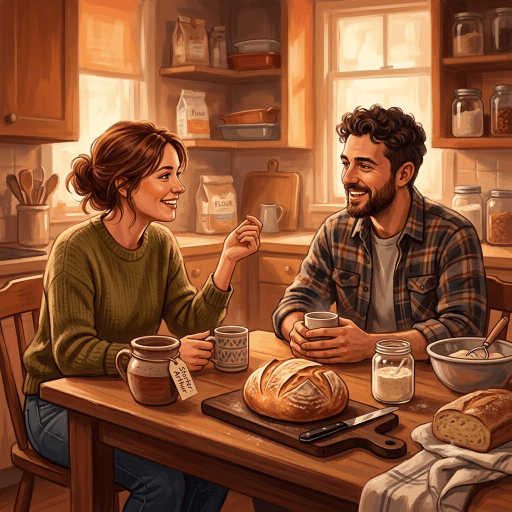
Jack and Emma dig into their home baking hobby, from naming their sourdough starters to their early failed loaves, and talk about why slowing down to bake bread from scratch has become such a meaningful weekend ritual.

PodcastB1FoodFree to learnPrintable worksheet
15mAudioEnglish with translations in EnglishQuizzes
Your interface language is the language you are learningMeanings and translations appear in the interface language, so they would only repeat the words. Switch the interface to a different language to look up words, translate sentences and see the meanings of your saved words.
Jack Dawson

Hello everyone, and welcome back to the Heylangs Podcast. I'm Jack Dawson. There's a jar on my kitchen counter right now. It bubbles. It smells sour. And yes, it has a name. If you know what I'm talking about, this episode is for you. Today we're talking about a hobby that's grown really popular over the last few years: baking bread at home. It might sound simple, but it's actually become a real passion for a lot of people, myself included, which surprises everyone who has ever eaten my cooking.

Emma Wells

And I'm Emma Wells. I have a jar with a name too, so no judgment here. I have to admit, I'm completely obsessed with baking bread on weekends now. It started as a random experiment about two years ago, and now I can't imagine a Saturday morning without flour all over my kitchen counter.

Jack Dawson

That's exactly how it started for me too! I remember watching a video online about making sourdough bread, and I thought, how hard could it possibly be? It turns out, it's harder than it looks, but that challenge is actually part of what makes it so satisfying.

Emma Wells

Sourdough is such a good example, because it's not just about following a recipe. You have to take care of a living starter, feed it regularly, and really pay attention to how it behaves. It taught me a lot of patience I didn't know I needed.

Jack Dawson

I named my sourdough starter, by the way. I know that sounds a little silly, but a lot of home bakers do this. Mine is called Doughy, and I feed him every morning before work. It's become a strange but comforting little ritual.

Emma Wells

That's not silly at all! Mine is named Gerald, and he's almost eighteen months old now. There's something oddly rewarding about keeping something alive and watching it grow stronger over time, even if it's just a jar of fermenting flour and water.

Jack Dawson

What got you started with baking in the first place, Emma? Was it something you'd always wanted to try, or did it just happen unexpectedly one day?

Emma Wells

Honestly, it happened during a particularly stressful period at the newspaper where I used to work. I needed something calming to do on weekends that didn't involve staring at a screen. Kneading dough turned out to be surprisingly therapeutic, almost like a form of meditation with your hands.

Jack Dawson

I completely understand that feeling. There's something really grounding about working with your hands, especially after spending all week typing on a keyboard. Baking forces you to slow down and pay attention to small details, which is honestly kind of rare in everyday life.

Emma Wells

Exactly. You can't rush bread, no matter how impatient you feel. The dough needs time to rise, and if you try to speed up the process, the final result usually suffers. It's taught me to be more patient in other areas of my life too, oddly enough.

Jack Dawson

Let's talk about failures too, because I think that's an important part of learning to bake. My first few loaves came out incredibly dense, almost like bricks. I remember genuinely wondering if something was wrong with my oven, but it was really just my technique.

Emma Wells

Oh, I have plenty of failure stories! My first sourdough loaf didn't rise at all because my starter wasn't strong enough yet. It was flat and gummy, but I still ate it anyway, mostly out of stubbornness and a refusal to waste the ingredients.

Jack Dawson

That stubbornness is important, though, because baking really does get better with practice. I probably made ten mediocre loaves before I finally got one that had a proper crust and an open, airy crumb. My friend Marco still calls my early bread 'the doorstop,' which is fair. Each failure taught me something specific I needed to adjust.

Emma Wells

It's funny how baking bread teaches you to troubleshoot, almost like solving a small puzzle every weekend. Was the dough too wet? Did I let it rise for too long? Was my oven too hot? Every loaf gives you feedback if you pay close attention.

Jack Dawson

Do you follow specific recipes, or have you started experimenting on your own now? I've started adjusting hydration levels and trying different flour combinations, which felt intimidating at first but has become really fun once I understood the basic principles.

Emma Wells

I still follow recipes for the most part, but I've started adding my own touches. Last month, I made a loaf with rosemary and sea salt mixed into the dough, and it turned out incredible. Experimenting feels a lot less scary once you understand the fundamentals.

Jack Dawson

Baking also connects to a bigger movement, I think, of people wanting to slow down and make things from scratch again. A lot of my friends started baking during difficult, stressful periods, and it seems like the habit stuck around even after things calmed down.

Emma Wells

That's such a good point. There's something deeply satisfying about eating something you made completely from scratch, especially in a world where so much of what we eat comes pre-made or from a package. Bread feels honest in a way that's hard to explain.

Jack Dawson

Let's talk equipment too, because I know a lot of people assume you need fancy tools to bake good bread. Honestly, I started with just a mixing bowl, a wooden spoon, and my regular oven. I didn't buy a proper dutch oven until months later.

Emma Wells

I agree completely. My first loaves were baked on a simple baking sheet, and they turned out just fine. Eventually I bought a banneton basket to help shape the dough, but it's definitely not a requirement to get started with baking bread.

Jack Dawson

Sharing bread with other people is one of my favorite parts of this whole hobby, honestly. When I go up to Leeds to see my parents, I bring a loaf almost every time now, and my dad always comments on how much better it's gotten since I first started, which is his polite way of saying the first ones were terrible.

Emma Wells

I do the same thing with my neighbors! I leave a small loaf on their doorstep sometimes, just as a nice surprise. It's become a lovely way to connect with people, especially in a city where neighbors don't always talk to each other very much.

Jack Dawson

I think it also helps to understand a little bit of the science behind bread, even at a basic level. Once I learned how gluten develops when you knead dough, and how yeast actually produces the gas bubbles that make bread rise, the whole process suddenly made a lot more sense to me, rather than feeling like random magic.

Emma Wells

That's so true. Understanding fermentation changed everything for me too. Once I realized that a slower rise, often overnight in the fridge, actually develops more flavor than a quick rise at room temperature, I completely changed how I plan my baking schedule around my weekends now.

Jack Dawson

Let's talk about different types of bread too, because sourdough isn't the only thing worth trying. I've branched out into baking focaccia lately, which is honestly a lot more forgiving than sourdough. You just press your fingers into the dough and drizzle it generously with olive oil and rosemary.

Emma Wells

I love focaccia! I've also gotten into baking rye bread recently, partly because my partner Sam eats it with almost every meal. It has a much denser texture and a slightly sour, earthy flavor that pairs really nicely with butter and cheese.

Jack Dawson

Do you ever use a bread machine, or do you always knead everything by hand? I actually bought a stand mixer last year, mostly to save my arms from getting tired, but I still knead simpler doughs by hand because I genuinely enjoy the physical process.

Emma Wells

I knead everything by hand too, mostly because I find it relaxing rather than tedious. My friend Sofia bought a bread machine and swears by it for convenience, especially on busy weekdays, but for me, the hands-on process is honestly half the appeal of the whole hobby.

Jack Dawson

One thing I didn't expect was how much I'd enjoy using sourdough discard in other recipes. Instead of throwing away the extra starter when I feed it, I now make pancakes, crackers, and even pizza dough with it, which feels great since nothing gets wasted.

Emma Wells

That's such a smart approach. I've started making sourdough discard waffles on Sunday mornings, and they've become Sam's favorite breakfast. It feels good knowing that the whole process is efficient, without any part of the starter or ingredients going to waste unnecessarily.

Jack Dawson

I've also joined an online baking community where people share photos of their loaves and troubleshoot problems together. It's surprisingly supportive, and I've learned more from other home bakers' mistakes and tips than I ever could have learned from a cookbook alone.

Emma Wells

I follow a similar group, and it's honestly become one of my favorite parts of the hobby. Seeing other people's failed loaves makes me feel a lot less alone in my own baking disasters, and their tips have genuinely improved my technique over time.

Jack Dawson

There's also something inspiring about visiting a proper local bakery and seeing how professionals handle the craft. I visited one last month and watched the baker shape dozens of loaves in the time it took me to shape just one at home.

Emma Wells

I had a similar experience at a bakery near my Nan's house in Cardiff. The baker let me watch him score the loaves before baking, cutting those beautiful patterns into the dough with a razor blade. It gave me a whole new appreciation for how much skill goes into something that looks so simple.

Jack Dawson

Cost is another interesting factor worth mentioning, because baking your own bread can actually save quite a bit of money over time, especially if you bake regularly. A bag of flour costs far less than buying several artisan loaves from a bakery every single week.

Emma Wells

That's true, although I'll admit the initial cost of tools and ingredients can add up at the start. Once you have the basics covered, though, homemade bread definitely becomes more affordable, and you also get the added bonus of controlling exactly what goes into it.

Jack Dawson

Seasonal baking has become something I really look forward to as well. In autumn, I bake pumpkin bread with cinnamon and nutmeg, and around the holidays, I always make cinnamon rolls that fill the entire flat with an incredible smell. Even Coco gets out of her bed early for those, and she's a dog who takes her sleep seriously.

Emma Wells

That sounds amazing. I do something similar around Christmas, baking bara brith, the spiced Welsh fruit bread my Nan makes every December. It's become a tradition Sam and my brother Rhys now look forward to every year, which makes the whole baking process feel even more meaningful.

Jack Dawson

Baking with kids is actually something I want to try more of, honestly. My niece Mia visited last month, and she helped me shape a small batch of dinner rolls. She was so proud when they came out of the oven, even though a few of them were a bit lopsided, and she told me they were better than mine, which was probably true.

Emma Wells

My friend Priya's kids love helping too when they visit, even though their contribution mostly involves eating flour and making a huge mess on the counter. I think getting kids involved early is a great way to teach them patience and give them a real sense of accomplishment when the bread finally comes out golden and warm.

Jack Dawson

I've also started experimenting with different types of flour lately, beyond just standard all-purpose flour. I bought some whole wheat flour and a bag of rye flour from a small local mill, and the difference in flavor compared to store-bought flour was honestly quite noticeable.

Emma Wells

That's something I want to try too. I recently discovered a local mill about an hour from my house that stone-grinds their flour in small batches. Apparently, the flavor and nutrition are much better than mass-produced flour, though I haven't made the trip to buy some just yet.

Jack Dawson

Some people even take formal baking classes to improve their skills faster, which is something I've considered doing myself. A friend of mine took a weekend sourdough workshop last year and said it helped her understand shaping techniques in just a few hours that had taken her months to figure out alone.

Emma Wells

I took an online baking course a few months back, actually, and it was incredibly helpful for understanding hydration ratios and proper oven temperatures. Sometimes watching an experienced baker demonstrate a technique live, even through a screen, teaches you far more than simply reading written instructions ever could.

Jack Dawson

There's also a nice sense of ritual that comes with baking on a set schedule every weekend. I usually mix my dough on Friday evening, let it rest slowly in the fridge overnight, shape it Saturday morning, and bake it right before lunch, filling my whole apartment with that incredible smell.

Emma Wells

My schedule is fairly similar, and I've genuinely come to look forward to that entire process, not just the finished loaf. It gives my weekend a nice rhythm and something to look forward to, especially after a long and busy week at work.

Jack Dawson

Before we finish up, what advice would you give someone who wants to start baking bread but feels intimidated by the whole process? I know it can seem overwhelming at first, especially with all the technical terms involved.

Emma Wells

I'd say just start with a simple recipe and accept that your first few loaves probably won't be perfect. Don't get discouraged by dense or flat bread. Every failed loaf actually teaches you something useful that will make your next attempt a little bit better.

Jack Dawson

That's great advice. I'd also add that you don't need expensive equipment to get started. A basic recipe, some patience, and a willingness to learn from your mistakes will get you further than any fancy gadget ever could.

Emma Wells

Thanks so much for listening to our little bread-obsessed conversation today. Maybe this weekend is a good time to try baking your very first loaf, even if it turns out a little lopsided or dense, because every experienced baker started exactly where you are now.

Jack Dawson

Remember, a little practice every day makes a big difference, whether you're kneading dough or practicing your English. It really is one of the most rewarding weekend rituals I've picked up in years, and I'd encourage anyone curious to simply give it an honest try. Honestly, that steady sense of progress from one weekend to the next is a big part of why I keep coming back to it. Keep listening, keep speaking, and don't be afraid of a few failed attempts along the way. See you next time!

Tap any underlined word for its meaning.

What do you think?

  • Describe a time you tried to bake or cook something new. How did it turn out?
  • Why might slowing down to make something from scratch, like bread, matter in today's fast-paced world?
  • What is a hobby that has taught you patience, similar to how baking teaches Jack and Emma?
0:00 / 0:00

About this lesson

Jack and Emma dig into their home baking hobby, from naming their sourdough starters to their early failed loaves, and talk about why slowing down to bake bread from scratch has become such a meaningful weekend ritual. It is written at B1 level, so Main ideas of real texts. Read it, listen where audio is available, tap words you do not know and finish with the quiz.

Frequently asked questions

What level is this lesson?
It is B1 (Intermediate) on the CEFR scale: Main ideas of real texts.
Is this lesson free?
Yes. You can read the whole lesson for free. Free accounts have daily limits on word look-ups, quizzes and AI tools; Premium removes them.
How do I understand words I do not know?
Tap any word for its meaning, save it to your word list, and review it later with spaced repetition.